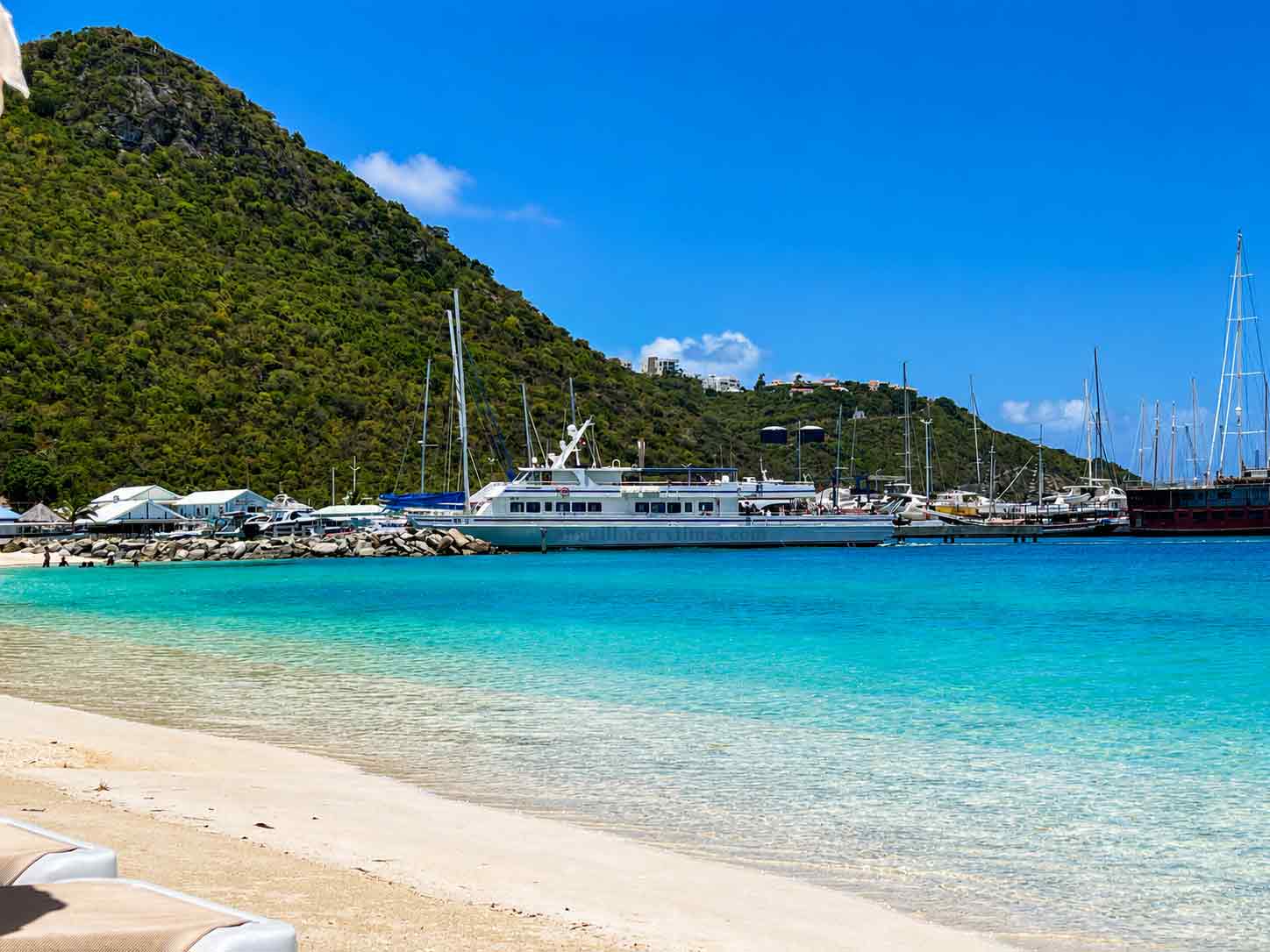

One question travelers ask more often than you might think is why the public ferry from Anguilla does not run directly to the Dutch side of St. Maarten, especially Philipsburg, Bobby’s Marina, or the cruise port area.
It is a fair question. Philipsburg is busy, well known, and already connected to ferry routes such as Great Bay Express to St. Barths. Many visitors also land at Princess Juliana International Airport on the Dutch side, so it can feel natural to wonder why Anguilla’s regular public ferry does not simply go there instead of Marigot.
The answer is not that the Dutch side is ignored. Dutch-side service to Anguilla exists, but it is usually handled through private and shared airport-area ferry operators near SXM Airport. The public ferry is a different type of service. It is built around the shorter, more established, more affordable Blowing Point to Marigot route.
The public ferry is built around Marigot for a reason
The Blowing Point to Marigot route is the standard public ferry connection between Anguilla and French St. Martin. It is the route most residents, workers, day trippers, and budget-conscious visitors already understand. It has the daily rhythm, terminal process, public schedule, taxi flow, and passenger habits built around it.
A public ferry route works best when it is simple, repeatable, and easy for travelers to understand. Passengers know where to go. Operators know where to dock. Immigration and port staff understand the daily movement. Taxi drivers and car rental companies know when passengers are arriving. That matters more than many visitors realize.
Marigot is also a practical geographic choice. The crossing from Blowing Point to Marigot is short, usually about 25 minutes on the water. A longer route to Philipsburg would add more time, fuel, crew hours, and exposure to sea conditions. That would likely make the service harder to keep affordable as a public ferry.
Philipsburg serves a different travel market
Philipsburg is one of the busiest visitor areas in St. Maarten. It is closely tied to cruise traffic, shopping, the boardwalk, excursions, and ferry routes to destinations such as St. Barths. That makes it valuable, but not necessarily ideal for Anguilla’s everyday public ferry service.
A route that looks convenient on a map can become complicated once you add immigration, taxis, luggage, cruise passengers, road traffic, parking, and port operations. Bobby’s Marina and the Philipsburg waterfront already serve a heavy mix of ferry passengers, cruise visitors, day tours, taxis, and local traffic.
Adding a regular public Anguilla ferry into that environment would not be as simple as assigning a boat to a new dock. It would require passenger control, customs and immigration coordination, reliable waiting space, local transport planning, baggage handling, and enough demand in both directions to justify the route.
The Dutch side is already served, just differently
For travelers trying to connect between SXM Airport and Anguilla, the Dutch side already has ferry options. These are usually private or shared ferry services operating from the airport-area dock, not from Bobby’s Marina in Philipsburg.
That setup makes sense because most visitors using the Dutch side are arriving or departing through Princess Juliana International Airport. Their priority is not usually Philipsburg. Their priority is getting from the airport to Anguilla with luggage, passports, and timing handled as smoothly as possible.
The airport-area ferry model is priced differently because it solves a different problem. It is more of a transfer service than a public ferry. Operators often coordinate around flight arrivals, passenger manifests, luggage, reservations, and immigration paperwork. That is why it costs more than the public ferry from Marigot.
| Traveler need | Best option | Why |
|---|---|---|
| Lowest-cost public crossing | Blowing Point to Marigot public ferry | Shorter, established, frequent, and more affordable |
| SXM Airport to Anguilla with luggage | Dutch-side shared or private airport ferry | Built around airport transfers and reservations |
| Philipsburg to St. Barths | Bobby’s Marina / Great Bay Express | That area is already known for St. Barths ferry service |
| Anguilla to Philipsburg for shopping or business | Public ferry to Marigot, then taxi or rental car | Usually simpler than operating a full public ferry route to Philipsburg |
Bobby’s Marina is not the same kind of ferry hub
Bobby’s Marina is familiar to many travelers because of Great Bay Express, which operates between Philipsburg and Gustavia, St. Barths. But that does not automatically make it the best public ferry terminal for Anguilla.
The ferry traffic around Bobby’s Marina is strongly connected to the St. Barths market, especially visitors going between Philipsburg and Gustavia. That is a different travel pattern from the Anguilla public ferry, which is used daily by residents, workers, families, shoppers, day trippers, and visitors looking for an affordable inter-island connection.
A St. Barths ferry and the Anguilla public ferry may both be boats moving between islands, but they are not the same product. One is more destination-driven and excursion-oriented. The other is a daily transport link that needs to stay predictable and affordable.
Cruise traffic would make a simple route less simple
Philipsburg is a major cruise and tourism zone. On busy cruise days, the area can already feel full with ship passengers, tour buses, taxis, shoppers, water taxis, ferry passengers, and port activity. At certain times of year, that creates pressure on roads, sidewalks, pickup areas, and passenger processing.
A regular Anguilla public ferry would bring another steady flow of passengers into the same area. That would mean more arrivals, more departures, more passport checks, more luggage, more taxi pickups, more waiting passengers, and more pressure near an already active port zone.
For a visitor, it may sound convenient to arrive in Philipsburg. For a public ferry system, the question is bigger: can the terminal area handle that flow several times a day without creating delays, confusion, or congestion? That is where Marigot has an advantage because it is already organized around the Anguilla ferry routine.
Immigration is part of the route decision
Every trip between Anguilla and St. Martin or St. Maarten is international travel. Passengers are crossing between jurisdictions, so the route needs customs and immigration processing on both sides.
The Marigot route already has a familiar public ferry process. The Dutch-side airport ferry services also have their own process because they are designed around reservations, manifests, passport details, luggage handling, and airport transfers.
A regular public ferry to Philipsburg would need a dependable immigration and customs setup that can handle walk-up public ferry passengers without disrupting existing Dutch-side port activity. That is possible in theory, but it would need staffing, space, approvals, and a strong business case.
Marigot also supports the local travel economy
The public ferry does more than move people across the channel. It supports activity around Marigot. Passengers arriving from Anguilla use taxis, car rentals, nearby restaurants, bakeries, shops, and other services before heading deeper into St. Martin or across to the Dutch side.
That movement matters for the local economy. The ferry helps bring steady daily traffic into Marigot instead of sending even more visitors into the already crowded Philipsburg and cruise-port corridor.
Marigot has its own tight roads and limited parking, but the town is used to the ferry rhythm. Taxi drivers know the schedule. Car rental operators know when people arrive. Travelers can walk into town, get food, meet a driver, or continue to Grand Case, Simpson Bay, Maho, Philipsburg, or SXM Airport.
Roads, parking, and passenger flow matter more than the dock itself
When people ask why a ferry does not simply go to a different dock, they often focus only on the water. But a ferry route is not just a boat crossing. It is a full passenger system.
A working public route needs a dock, ticketing, waiting space, immigration, baggage movement, taxi access, pickup areas, parking, signs, schedule communication, and a way to recover when boats are delayed. If any of those pieces are weak, the route becomes frustrating for travelers.
That is why Marigot continues to make sense. It may not be perfect, but it is already the known public ferry gateway for Anguilla. Philipsburg may be busier and more famous, but busier does not always mean easier.
The public ferry has to stay affordable
The Anguilla public ferry is popular because it is practical and affordable. A longer public route to Philipsburg would likely cost more to operate. More distance means more fuel, more time, and more wear on vessels. More complex port handling can also increase operating pressure.
If fares rise too much, the route stops feeling like the public ferry. If fares stay too low, the route may not make financial sense for operators. That is one reason the Dutch-side option has developed as a higher-priced airport transfer service instead of a low-cost public ferry.
Would a Philipsburg public ferry route ever make sense?
It could make sense if there were enough year-round demand, approved docking arrangements, reliable customs and immigration staffing, proper passenger space, and clear coordination with local transport. A limited route may sound simple, but even one or two trips a day would need all of those pieces in place.
The challenge is that the strongest Dutch-side demand is already near SXM Airport, not necessarily Philipsburg. Airport passengers want the closest practical ferry dock to their flight, while budget travelers usually accept Marigot because it keeps the crossing affordable.
That leaves Philipsburg in an awkward middle position for Anguilla. It is busy, but not always the most useful location for the main Anguilla passenger flow.
What travelers should do instead
| If you are trying to... | Use this option |
|---|---|
| Travel between Anguilla and St. Martin at the lowest cost | Use the public ferry between Blowing Point and Marigot |
| Go from SXM Airport directly to Anguilla | Book a shared or private Dutch-side airport ferry |
| Reach Philipsburg from Anguilla | Take the public ferry to Marigot, then taxi or rent a car |
| Visit St. Barths from Philipsburg | Use the St. Barths ferry service from Bobby’s Marina |
| Avoid tight flight connections | Use a pre-booked airport ferry or build in extra time |
| Travel with lots of luggage | Consider a private or shared airport transfer instead of a public ferry plus taxi |
The clearest way to understand it
The public Anguilla ferry does not usually go to Philipsburg or Bobby’s Marina because Marigot is the better fit for the public ferry model. It is shorter, established, easier to repeat throughout the day, and already connected to the passenger flow around Anguilla travel.
The Dutch side is still served, but through a different model. Airport-area ferry operators handle travelers who want a direct SXM connection, while Bobby’s Marina mainly supports St. Barths ferry traffic and cruise-adjacent travel.
So the answer is not simply that there is no ferry to the Dutch side. A better way to explain it is this: Anguilla’s public ferry system is built around Marigot, while Dutch-side Anguilla travel is handled by private and shared airport ferry services. Philipsburg and Bobby’s Marina are important ferry areas, but they are not the main public ferry gateway for Anguilla.
Frequently Asked Questions
Does the Anguilla public ferry go to Philipsburg?
The regular public ferry route is between Blowing Point, Anguilla and Marigot, French St. Martin. Philipsburg is not the main public ferry gateway for Anguilla.
Is there any ferry from the Dutch side of St. Maarten to Anguilla?
Yes. Dutch-side Anguilla service exists, but it is usually handled by private or shared ferry operators near Princess Juliana International Airport rather than the regular public ferry from Marigot.
Why does the public ferry use Marigot instead of Bobby’s Marina?
Marigot is the established public ferry route for Anguilla. It is shorter, more affordable, and already organized around the daily Anguilla passenger flow. Bobby’s Marina mainly serves other ferry markets, including St. Barths service.
Is Marigot better than Philipsburg for getting to Anguilla?
For the public ferry, yes. Marigot is the standard low-cost public route. For travelers arriving at SXM Airport with luggage, a Dutch-side shared or private airport ferry may be more convenient.
Could Anguilla add a public ferry to Philipsburg in the future?
It is possible, but it would need enough demand, approved docking, customs and immigration staffing, passenger space, taxi coordination, and a business case that makes sense year-round.
What is the best option if I am staying in Philipsburg and want to visit Anguilla?
Most travelers can take a taxi or rental car to Marigot and use the public ferry to Blowing Point. If convenience matters more than price, a private or shared Dutch-side ferry transfer may be a better option.