Driving on the Left in Anguilla: Tips for First-Time Visitors
August 20, 2025
7 min read
Share:
Jahmal Richard
Anguilla Ferry Times
The first time you drive in Anguilla, the island feels calm right up until the moment you pull away. Not because the roads are chaotic. They are not. It is because your instincts are loud. Your brain wants to drift right after every turn, your hands reach for a gear pattern that is not there, and your eyes keep checking the wrong side first.
The good news is that Anguilla is one of the gentler places to experience this for the first time. The island is only 16 miles long and 3 miles wide. Traffic is light, speeds are low, and most routes are short enough that confidence builds quickly. Within a day, left-side driving starts to feel normal. Within a few days, you will wonder why you were stressed at all.
Good to know
stay left after every turn, yield to traffic coming from the right at roundabouts, and drive at island pace. Those three things will carry you through most situations.
Jahmal Richard is a born-and-raised Anguillian who frequently uses the Blowing Point ferry crossing for personal and business travel. As an experienced software engineer, he built Anguilla Ferry Times to give local and international travelers clear ferry schedules, practical trip-planning tools, and useful insights for visiting Anguilla.
Quick takeaway:
Driving in Anguilla at a Glance
Topic
What to expect
Why it matters
Side of the road
Left
Your biggest mental shift happens after turns and at junctions.
Roundabouts
Clockwise flow, yield to the right
Most visitor mistakes happen here. There are only 5 on the island.
Speed limits
Posted in mph
30 mph on main roads, 20 mph in villages and school zones.
Rental cars
Often left-hand drive
Steering wheel position can feel unfamiliar on left-side roads.
Minimum rental age
Usually 25
Some agencies charge a young driver fee for under-25s.
License requirement
Temporary Anguilla permit (around US$20, arranged by most rental agencies)
Confirm this is sorted before you drive away.
Night driving
Main roads are lit; side roads and dirt tracks are darker
Keep your first night drive short and stick to main routes.
Why Anguilla Drives on the Left
As a British Overseas Territory, Anguilla follows left-side driving. If you have driven in the UK, Australia, or other Commonwealth destinations, the rhythm will feel familiar immediately. If you have only driven on the right, the island still makes the transition easier than most places. The pace is unhurried, the roads are flat, and the distances between places are short.
Approach your first day like you are learning a new skill rather than just remembering a rule. Be deliberate, allow more time than you think you need, and resist the urge to keep up with local drivers until the instinct has settled.
The Mental Trick That Keeps You in the Correct Lane
The simplest rule: keep yourself closer to the center line than the curb. If you are driving a left-hand drive rental, your seating position can make you feel like you are drifting too far left. That feeling is usually wrong. The center line is your anchor.
After every turn, say it out loud if you need to: stay left. Most mistakes happen when the road is empty and muscle memory takes over. The island is relaxed, but your habits are not.
Travel tip
If you are unsure after turning onto a quiet road, glance at the road edge and the center line. Your position should feel closer to the center than you are used to back home.
Roundabouts in Anguilla
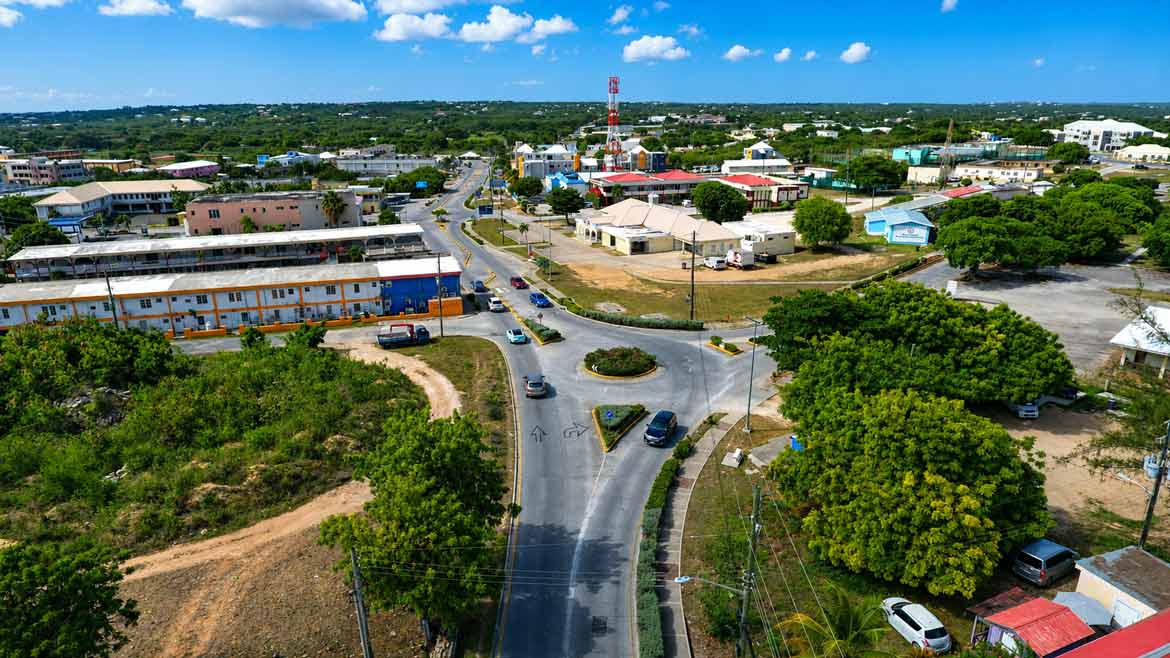
There are only 5 roundabouts on the entire island, so you will encounter them but not constantly. The rule is the same at each one: yield to traffic coming from the right. Enter when clear, move clockwise, and signal when exiting.
What throws visitors off is that the flow feels reversed. The first instinct is often to hesitate too long or enter too quickly. The correct approach is slow and deliberate: scan right, wait for a clear gap, enter smoothly, and commit to your lane.
Approach slowly and scan to the right.
Yield to traffic already in the roundabout.
Enter when there is a clear gap.
Keep a steady speed inside the roundabout.
Signal as you exit, and exit smoothly into the left lane.
Speed Limits and Realistic Driving Pace
Speed limits in Anguilla are posted in miles per hour. The standard limit on main roads is 30 mph, dropping to 20 mph in villages, school zones, and crossings. Those limits feel slow if you are used to wide highways, but they make sense once you meet a sudden speed bump, a narrow bend, or a goat in the road.
If your rental car's odometer shows kilometers per hour rather than mph, use these quick approximations to stay grounded.
Limit (mph)
Approx (km/h)
Where you will see it
20 mph
approx 32 km/h
Villages, school zones, and busy crossings
30 mph
approx 48 km/h
Main roads and connecting routes across the island
Good to know
The speed limit is a ceiling, not a target. If a road feels narrow, treat it as narrow. Island pace is the right pace.
Narrow Roads, Soft Shoulders, and the Island Reality
Anguilla has one main paved road running the length of the island, with smaller roads connecting villages, bays, and points of interest. Road quality varies. You will find smooth newer stretches like the Jeremiah Gumbs Highway connecting Blowing Point to The Valley, and rougher patched sections in other areas. Some side roads are unpaved.
When another car approaches on a narrow section, reduce speed and give space. Avoid drifting onto the soft shoulder, especially after rain. Local drivers know these rhythms well and will usually make room. Follow their lead.
Driving at Night
Night driving in Anguilla is straightforward on the main roads, which are reasonably well lit. Side roads and dirt tracks are a different story. Lighting can disappear quickly, and pedestrians, cyclists, and animals are harder to see than you expect.
If you arrive late, keep the first drive short and stick to main routes. Save the scenic exploration for daylight. If you do drive at night, slow down, increase your following distance, and set your navigation before you leave rather than while moving.
Common Mistakes First-Time Visitors Make
Turning and drifting right out of habit, especially onto quiet roads.
Entering roundabouts too quickly or hesitating so long that traffic backs up.
Driving too fast on a smooth stretch and meeting a sudden speed bump or narrow bend.
Setting up navigation while moving instead of while parked.
Underestimating how dark side roads and dirt tracks can be after sunset.
Travel tip
If a right turn feels intimidating, wait for a wide gap and cross at your own pace. Patience is always the safer option.
Car Rental and the Temporary Anguilla Driver's Permit
Visitors need a temporary Anguilla driver's permit to drive on the island. The permit costs around US$20 and is valid for up to 6 months. Most car rental agencies handle it on the spot, but confirm this before you drive away. You will need a valid driver's license from your home country.
Most rental agencies also require drivers to be at least 25 years old. Some will rent to drivers between 23 and 24 but charge a young driver fee. Confirm the age requirement when booking.
Before leaving the lot, do a quick pre-drive check. It takes two minutes and can save a headache later.
Confirm your temporary permit is arranged before you start the engine.
Ask what insurance coverage is included and what is optional.
Take a quick video of the car exterior and note any existing scratches.
Check for a spare tire, jack, and basic tools.
Top up fuel when you can. Stations are not everywhere on the island.
Arriving by Ferry or Airport: Your First 30 Minutes
Your first drive sets your confidence level for the rest of the trip. If you arrive by ferry at Blowing Point, you may be tired, excited, and carrying bags. If you arrive at the airport, you may be navigating an unfamiliar car in an unfamiliar lot. Either way, this is not the moment to rush.
Give yourself a simple warm-up route. Pick one clear destination, drive slowly, and do not stack decisions. If you need to review directions, do it while parked. If you are uncertain at a junction, let local traffic pass and go when you are ready. The island will not punish you for being careful.
Set your navigation while parked before moving.
Choose a simple first route with fewer turns.
Repeat stay left after each turn until it feels natural.
Treat every roundabout as a deliberate exercise: look right, then enter.
If it is dark, keep the first drive short and explore tomorrow.
Exploring Anguilla by Car
Once you settle into the rhythm, driving becomes part of the trip rather than a task you are managing. A rental car lets you move beyond the resort area and reach the island on your own terms. You can stop at a quiet bay because the water looks inviting. You can take the long way because the light is right. You can find lunch without coordinating a taxi.
If you are planning beach days, pair this guide with the beaches hub to choose shorelines based on current conditions rather than just reputation.